Diner DASH Adventures
- 3.8
- Rating
- 5.00M
- Installs
- Free
- Price

 Analysis by App-foxy
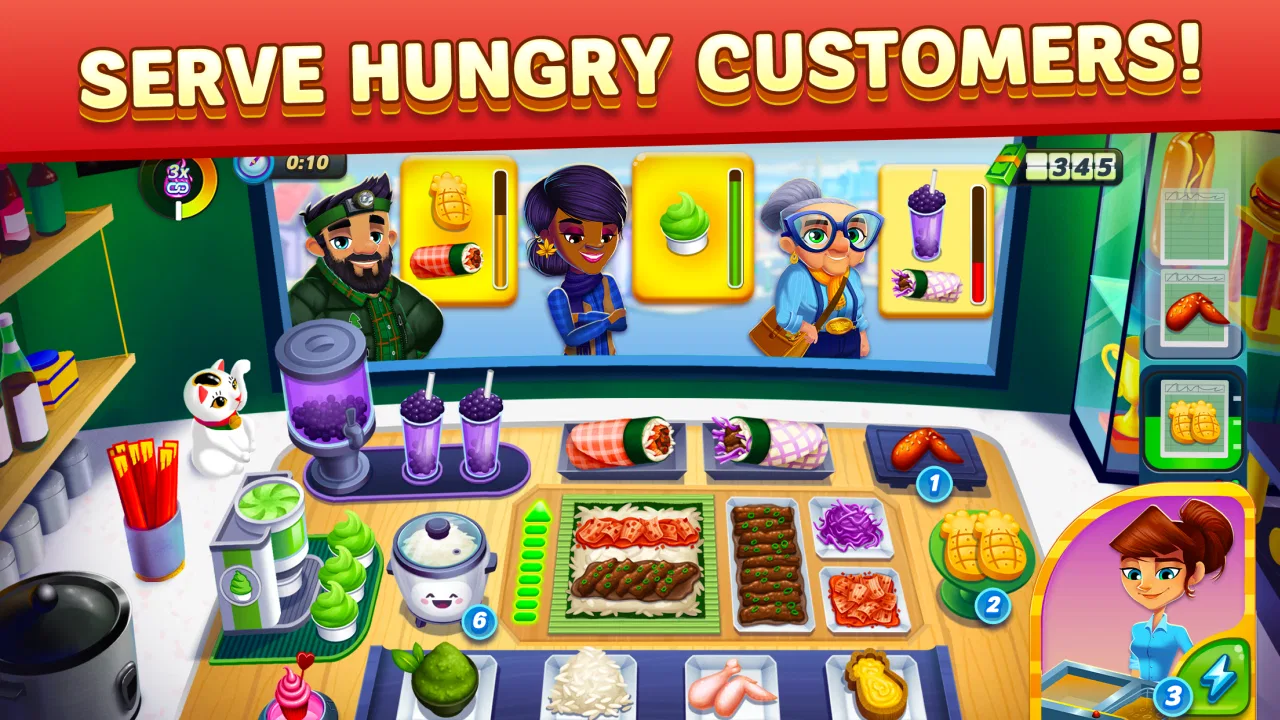
I went into Diner DASH Adventures expecting a quick casual game about serving customers, but it became more interesting once I paid attention to how it structures short-term goals. The basic appeal is immediate: you are working through diner-focused challenges, trying to keep service moving, and making decisions quickly enough to avoid letting a busy shift get away from you. That makes it easy to understand in a few minutes, while the broader progression gives each session a reason to lead into the next one.
My first impression was that this is best suited to people who enjoy active, task-based casual games rather than completely passive relaxation. It asks me to watch what is happening, choose what to handle next, and improve my timing through repetition. The presentation is light and approachable, but the play is not entirely mindless. Even when a level is short, I still have to think about order, attention, and whether I am reacting efficiently.
Glu released the game on June 18, 2019, and it remains a recognizable choice in the casual category. It is free to start, rated for Everyone 10+, and has passed five million installs. Those details make its audience fairly clear: families and casual players can try it without an upfront purchase, while the age rating signals that younger players may still encounter elements that parents should understand before handing over a device.
You May Also Like

 Google Keep - Notes and lists
Google Keep’s Quiet Growth Shows the Appeal of Simpler Notes
As mobile work gets busier, Google Keep keeps winning a simple contest: capture a thought quickly, find it later, and get on with the day.

 Blood Strike: 2.5 Anniversary
Blood Strike’s Loadouts Turn Every Drop Into a Tactical Gamble
A close look at Blood Strike’s custom loadouts: how fast access to signature weapons reshapes its battle royale rhythm, rewards preparation, and narrows the gap between fights.

 Pandora - Music & Podcasts
Pandora’s Music Is Easy to Start, but Harder to Recover
Pandora’s strength is its low-effort path from a seed to a station. Its weak spot is how much confidence it asks you to place in connection, setup, and quiet recovery.

 8 Ball Pool
 Is Built on Rivalries, Rematches, and Routine
A close look at the rivalries, rematches, shared routines, and unanswered safety questions that turn a quick pool match into a persistent mobile community.

 Samsung Music
’s Quiet Strength Is Playing What You Already Own
Its reach comes less from spectacle than from dependable access to a personal library. That simplicity is both the app’s strongest retention engine and its ceiling.

 AccuWeather: Weather Radar
AccuWeather Review: A Quick, Clear Forecast for Everyday Decisions
For everyday plans, the best forecast is the one you can understand quickly. AccuWeather makes rain timing, radar, and local conditions easy to act on, with a few trade-offs.
More From Our News Desk



How the early goals pull you into the diner
The opening works because the goals are easy to read. I do not need to learn a complicated control scheme before I can understand what a successful round looks like. Customers arrive, service needs to be managed, and the game gives me a concrete reason to keep trying when a shift does not go smoothly. That clarity matters in a casual game: I can play for a few minutes without first studying a long tutorial.
What I liked most about the early structure is the way it turns simple actions into small tests of attention. At first, completing the obvious task feels sufficient. Soon, though, I start noticing that speed and sequence matter. It is not enough to react to the customer directly in front of me if another need is about to become urgent. The game gradually encourages me to look one step ahead instead of treating every action as an isolated tap.
That creates a useful distinction between playing and merely passing time. A player who wants a very calm experience may find the service rhythm more demanding than expected, especially during a crowded moment. Someone who likes compact goals, quick decisions, and the satisfaction of cleaning up a hectic situation will probably connect with it faster.
The early objectives also give me a practical way to judge whether the game is a good fit. If I enjoy repeating a level to improve my handling of a rush, the basic loop has enough purpose to hold my attention. If I prefer exploration, a long narrative, or a game where progress happens without pressure, this diner setting may feel narrow. Its strength is focus, not variety for its own sake.
Small improvements are more important than flashy rewards
One of the better parts of the experience is that progress is easy to feel even when the individual task is familiar. I begin by trying to finish the shift. After a few attempts, I am thinking about cleaner choices, fewer delays, and how to avoid creating a queue of problems. That change in mindset is a stronger motivator than simply being told that I have advanced.
I also found that the game rewards patience between attempts. When I fail to manage a busy sequence, immediately repeating the same approach is rarely the best answer. I get more from identifying the moment where my attention broke down. Was I focused too narrowly on one customer? Did I leave another task until it became urgent? That kind of self-correction gives the casual format a modest strategic layer.
The game’s current version is 1.74.0, which is useful to know when checking compatibility or deciding whether an older device is suitable. It requires Android 8.0 or later. On a supported phone, I would still recommend closing unnecessary background apps before a longer session, not because the game is unusually complicated, but because timing-based play feels worse when the device is already struggling.
Where the challenge begins to matter
The difficulty curve is most effective when it increases the number of things I must notice rather than simply making every action feel faster. A good service challenge asks me to prioritize. I have to decide what deserves attention now and what can wait briefly. That makes improvement feel earned, because I am developing a better routine instead of relying only on quicker fingers.
There is a trade-off here. Players who enjoy a relaxed pace may see the growing pressure as unnecessary friction. The game is still casual in its presentation, but “casual” does not mean every moment is stress-free. A hectic round can be satisfying when I am in the mood for it, yet it can also be the wrong choice after a long day if I only want something soothing.
My most useful approach was to treat each shift as a sequence of priorities rather than a race from the first second. I watched for the next likely source of trouble, completed actions that would prevent a backlog, and avoided spending attention on a low-risk task while a more urgent one was developing. This is the kind of practical habit that makes later rounds feel more manageable without pretending that the game becomes effortless.
That approach also explains why the game can appeal to different players for different reasons. A newcomer can enjoy the immediate diner fantasy, while a more experienced casual player can focus on efficiency. The same round can therefore feel simple at first and surprisingly demanding after I start caring about how well I perform.
Progress, pacing, and the pressure to keep playing
The progression works best when I use it as a series of nearby targets. I am not only asking whether I can complete the current challenge; I am also looking for the next small improvement that will make the following attempt cleaner. This creates a steady rhythm: play, notice a mistake, adjust, and try again. It is a familiar structure for the genre, but the diner setting gives those decisions a clear visual context.
Unlocks and advancement are most satisfying when they feel connected to what I have just learned. If a new stage follows a successful stretch, I have a reason to test myself again. The pacing is less effective when I feel that I am repeating a routine without a meaningful change in the problem. That is where personal tolerance matters. Some players enjoy polishing the same type of performance; others will want broader mechanical variety sooner.
I would not describe this as a game I play for a deep simulation of restaurant management. Its appeal is the immediate pressure of handling service, not detailed business planning or a realistic kitchen workflow. That distinction is important when comparing it with other casual titles. It offers more active decision-making than a simple matching game, but it does not replace a management simulator for someone who wants menus, staffing, finances, or long-term economic choices.
Compared with a slower puzzle game, this one gives me less time to examine every move. Compared with an endless runner, it gives me more control over priorities and a clearer sense that my decisions caused the result. Compared with a purely decorative time-management game, the challenge feels more central to the experience. Those differences help explain who should choose it: players who want short, structured bursts with a little pressure rather than a completely hands-off pastime.
A realistic everyday session
I can easily imagine using it during a short break between errands. I might have ten minutes while waiting for an appointment, start a shift, and finish with a clear sense of progress rather than stopping in the middle of an open-ended activity. The compact goals make that possible, although I would avoid beginning a demanding round if I know I may need to put the phone down immediately. A sudden interruption is more frustrating when the game is asking me to maintain a rhythm.
At home, it works differently. I can play several rounds and deliberately practice the parts that caused trouble earlier. That is when the pacing becomes more engaging, because I am not simply consuming content; I am trying to become more consistent. The game is a better fit for this kind of repeated improvement than for someone who wants every session to offer a completely new experience.
For parents, the Everyone 10+ rating is worth considering alongside the game’s free entry point. The title is accessible, but free-to-play design can encourage extra spending, and the store summary specifically notes in-game purchases and random items. I would set purchase controls before letting a child play unsupervised. That is not a criticism of the diner loop itself; it is a practical step whenever a game combines free access with optional paid content.
Where retention pressure becomes noticeable
The game’s strongest retention tool is the feeling that one more attempt could go better. I often know exactly what I want to fix, which makes restarting feel reasonable instead of arbitrary. That is good design for a casual audience, but it can also make the boundary between “I am improving” and “I am chasing progress” easy to miss.
The presence of random items and purchases adds another layer of caution. The available purchase range runs from $0.99 to $99.99 per item, so I would not treat the free label as the complete cost picture for every player. Someone who is comfortable enjoying the core loop without buying anything may be perfectly happy, but anyone who dislikes randomized rewards or spending prompts should approach it carefully.
My advice is to decide on a personal rule before playing: either keep the experience strictly free or set a firm limit that cannot be exceeded. That makes it easier to evaluate the game on its actual play rather than allowing a difficult stretch to pressure me into paying. If the only satisfying route seems to involve purchases, I would stop and reconsider whether this is the right casual game for me.
This is also where the game may lose players who prefer a clean, one-time purchase. A paid alternative can be better for someone who wants predictable costs and no random-item element, even if that alternative has fewer ongoing incentives. On the other hand, a player who likes free experimentation may value being able to try the diner loop before deciding whether it deserves more time.
Who will enjoy it, and who should skip it
I would recommend it to players who like time-management challenges, short objectives, and gradual improvement through repetition. It is especially suitable for someone who enjoys the moment when a chaotic round finally becomes organized. The controls and goals are approachable enough for casual play, while the need to prioritize gives experienced players something to refine.
I would be more hesitant to recommend it to players who want a quiet game with no urgency. I would also point elsewhere for anyone seeking a substantial story, a realistic restaurant simulation, or a competitive multiplayer focus. The diner theme is the frame for the challenge, not a promise of a broad management sandbox.
People who are sensitive to in-app purchase pressure should make the same decision carefully. The game costs nothing to download, but optional purchases and random items can change how comfortable the experience feels. I can enjoy the service challenges without treating spending as necessary, yet that may require discipline from the player rather than relying entirely on the game to remove temptation.
My verdict on the progression
After spending time with Diner DASH Adventures, I think its progression succeeds when I focus on the quality of each attempt rather than rushing toward the next reward. The early goals are clear, the later pressure gives familiar tasks more weight, and the strongest moments come from learning how to anticipate trouble. That is enough to make the loop more substantial than its cheerful presentation initially suggests.
Its limitations are equally clear. The structure can feel repetitive if I do not enjoy refining the same kind of service performance, and the free-to-play setup deserves attention because purchases and random items are part of the experience. The game also asks for more concentration than someone may expect from a casual title. Those are not deal-breakers for me, but they affect who I would recommend it to.
The average rating is 3.8 from around 89 thousand ratings, with roughly 15 thousand written reviews. I read that as a sign of a game with a real audience but not universal appeal: plenty of players find the loop worthwhile, while others likely encounter the pacing or monetization limits. More than five million installs show that the concept has broad reach, but popularity alone does not make it the right fit for every phone or play style.
My final recommendation is simple: try it if you want a free casual game built around quick diner decisions and measurable improvement, and decide early whether the pressure feels motivating or tiring. I would keep purchases restricted, play in short sessions when I want focused activity, and choose a different title if I want a slower puzzle, a deeper simulation, or a predictable one-time cost. For the right player, the game makes ordinary service tasks surprisingly engaging; for everyone else, the same repetition may become the reason to move on.
FAQs for Diner DASH Adventures
01What is Diner DASH Adventures?
Diner DASH Adventures is a fast-paced time-management and restaurant simulation game for mobile devices. You help Flo rebuild and manage DinerTown by serving customers, preparing meals, completing orders, and restoring different locations. Alongside the restaurant gameplay, the app includes story-driven tasks, town improvements, character interactions, and a variety of challenges that gradually unlock as you progress.
02Is Diner DASH Adventures free to download and play?
Yes, Diner DASH Adventures can be downloaded and played for free, but it includes optional in-app purchases. These purchases may provide extra energy, boosters, currency, or other helpful resources that can speed up progress. You can enjoy the main experience without paying, although the energy system and waiting periods may become more noticeable during longer play sessions.
03Does Diner DASH Adventures require an internet connection?
An internet connection is generally recommended, and some features may require you to be online. Connectivity can be needed for loading events, synchronizing progress, processing purchases, receiving updates, and accessing certain live content. While some gameplay may work temporarily without a stable connection, the experience is more reliable when using Wi-Fi or mobile data.
04Is Diner DASH Adventures suitable for children?
Diner DASH Adventures is colorful, cartoon-style, and relatively easy to understand, making it appealing to younger players and families. However, parents should be aware of optional in-app purchases and possible advertisements or promotional offers. The game also uses timed mechanics that may encourage repeated play, so parental controls and purchase restrictions are recommended for children.
05What devices are compatible with Diner DASH Adventures?
Diner DASH Adventures is designed for modern Android and iOS smartphones and tablets, but compatibility depends on the operating system version and the device’s available storage and performance. Before downloading, check the current requirements on Google Play or the App Store. Keeping your device and the game updated can also help prevent crashes and performance issues.
Pros
- Fast
- satisfying levels that are easy to play in short sessions.
- Many restaurant themes keep the visual experience feeling fresh.
- Time-management gameplay offers a good challenge as skills improve.
- Character interactions add charm beyond the basic serving mechanics.
- Regular events can provide extra goals and rewards for returning players.
Cons
- Energy limits may interrupt play when you want longer sessions.
- Some upgrades and progress can feel slow without premium currency.
- Later stages become hectic and may frustrate casual players.
- Frequent tasks and events can make the game feel repetitive over time.
- An internet connection may be required for several features and updates.

Diner DASH Adventures
Gallery